
Table of Contents
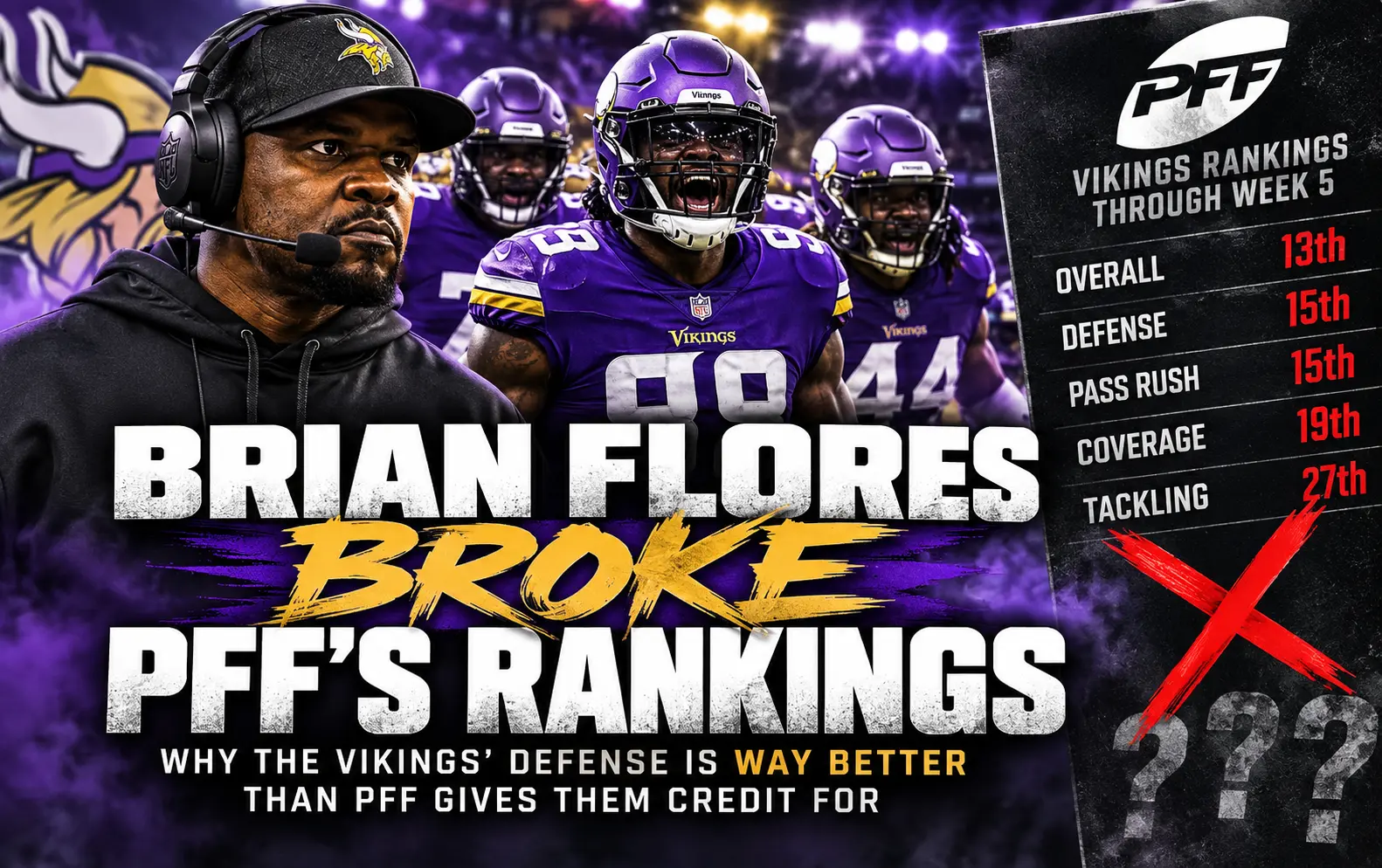
Brian Flores may have built a defense that exposes the limits of traditional football rankings. Through five games of the 2026 season, the Minnesota Vikings defense is playing like one of the NFL’s most disruptive units. Yet a widely shared snapshot of PFF-based team rankings placed Minnesota 15th in defense, while the same set of rankings had the Vikings 13th overall.
That gap between the on-field results and the ranking has sparked a fair question: are the numbers fully capturing what Flores is asking his defense to do? The Vikings defense is not simply lining up in a familiar front, rushing four and asking the secondary to cover. They are changing the picture before the snap, sending pressure from unexpected places and forcing quarterbacks to solve a different puzzle on nearly every dropback.
There is a difference between saying PFF’s grades are useless and saying they may not tell the whole story. Minnesota’s early-season performance makes the second argument compelling.
The Vikings’ results look like those of an elite defense
The production through Week 5 is hard to dismiss. Minnesota entered its bye week after a 23-13 win over New Orleans, a game in which the defense limited the Saints to 96 passing yards and forced three turnovers. Cornerback Byron Murphy Jr. intercepted two passes, and the Vikings continued to make life uncomfortable for opposing quarterbacks.
According to NFL.com’s Week 5 analysis, Flores sent extra rushers on 61.5% of defensive snaps against the Saints. The Vikings defense recorded only one sack, but generated pressure on half of its defensive plays. New Orleans quarterback Tyler Shough finished 16-of-25 for 96 yards, with no touchdowns and two interceptions.
That is the key to understanding this defense. A blitz does not have to end in a sack to work. It can force a rushed decision, erase a first read, shorten the quarterback’s clock or make a throw arrive a fraction late. When those effects show up repeatedly, the defense can dominate a game without piling up a huge sack total.
The broader numbers reinforce the argument. FOX Sports’ defensive rankings through Week 5 placed the Vikings defense second in total defense, allowing 259.8 yards per game. Pro-Football-Reference’s 2026 opponent defensive statistics listed the Vikings with 64 points allowed across five games, 10 takeaways and just 4.6 yards allowed per play.
Brian Flores is not running a conventional defense
Flores’ system is built around uncertainty. Before the snap, an offense may see a crowded line of scrimmage and have to account for pressure from several directions. After the snap, some of those defenders may rush while others drop into coverage. A linebacker can attack a gap, a defensive back can become a blitzer, and a player who appears responsible for one zone can rotate elsewhere.
The point is to make the quarterback identify the pressure correctly and make a good decision under time pressure. If the offense changes its protection to handle one threat, Flores can attack somewhere else. If the quarterback checks to a quick throw, Minnesota can have defenders waiting in the passing lane. The defense is trying to create hesitation before the ball is even snapped.
It is a high-demand approach. Players have to communicate, understand multiple responsibilities and react quickly. But when it works, the defense can create negative plays and turnovers even when an individual defender’s box score looks ordinary.
That is why a single grade, or even a collection of individual grades, may struggle to tell the entire story. A safety’s assignment might be to disguise pressure and then occupy a route that never comes his way. A linebacker might force a protection adjustment that frees a teammate to get home. The result can be a hurried throw or a stalled drive, even if the player who helped create it does not record a tackle, sack or pass breakup.
Why PFF’s rankings can miss the bigger picture
PFF grades are designed to evaluate individual players on a play-by-play basis, and those grades can provide useful detail. But the Vikings discussion highlights a broader issue with turning player evaluations into a simple team ranking. A defensive system’s value is not always the sum of the most visible individual performances.
The screenshots circulating after Week 5 show a striking contrast: Theo Jackson’s 63.7 grade ranked 42nd among 96 safeties, Josh Metellus’ 40.2 ranked 90th, and Harrison Smith’s 31.5 ranked 95th. Those numbers are individual grades, not a direct measure of the Vikings’ overall defensive effectiveness. A separate team ranking that lists Minnesota 15th on defense should not be treated as interchangeable with the NFL’s scoring, yardage, pressure or turnover rankings.
There is also a timing issue. A ranking is a snapshot, and different systems prioritize different inputs. Player grades, efficiency metrics, points allowed and yards allowed answer different questions. Some evaluate individual execution; others measure the outcome of the full defensive unit. They can disagree without any one statistic being fabricated or worthless.
Still, when a team is allowing very few points, limiting yardage, creating takeaways and consistently generating pressure, a mid-tier overall label deserves scrutiny. It may say as much about what the ranking emphasizes as it does about the quality of the defense.
The results are bigger than one player’s grade
Murphy’s two interceptions against New Orleans were the most obvious highlights, but the Vikings’ success is rooted in the structure around him. Pressure can speed up a quarterback’s internal clock. Disguised coverage can make the first read less attractive. A defensive line that wins quickly can turn a complicated coverage call into a straightforward third-down stop.
And the approach has consequences for how offenses prepare. Opponents have to spend time identifying pressure looks, planning protection rules and building answers for blitzes that may not arrive as expected. That preparation can limit the time available to work on the rest of the game plan. Even if an offense avoids a disastrous turnover, the uncertainty can disrupt its rhythm.
Of course, five games do not settle the debate for an entire season. The Vikings will face different quarterbacks, protection schemes and offensive play-callers. Opponents will study the tape and try to punish the pressure with screens, quick throws and well-designed protection checks. The Vikings defense will need to keep disguising its intentions and avoid giving offenses easy answers.
The Vikings defense deserve to be judged by what they are doing
The argument is not that PFF should be ignored. Its grades can help explain individual performances and identify areas that need improvement. The problem comes when a single ranking is treated as the final word on a defense that operates in an unusual way.
Through five weeks, Minnesota’s results are those of a top-tier unit: strong scoring defense, limited yardage, takeaways and pressure created at an extraordinary rate. NFL.com’s report on the Saints game described Flores sending extra defenders on 61.5% of snaps, while the Vikings turned that aggression into a performance that kept New Orleans from reaching 100 passing yards.
Flores has built a defense that thrives on making offenses uncomfortable. If the Vikings continue producing these results, rankings that place them in the middle of the pack will look increasingly disconnected from what happens on Sundays. The fairest conclusion for now is simple: PFF grades offer one lens, but they do not capture every advantage created by Minnesota’s scheme.
What do you think? Are PFF’s rankings underrating Brian Flores and the Vikings because their defense is so difficult to evaluate, or will those individual grades eventually catch up with the team’s results?
How good is the Vikings defense through Week 5 of 2026?
Minnesota has been among the NFL’s best defenses by several team-level measures. Through five games, the Vikings allowed 64 points, averaged 4.6 yards allowed per play and recorded 10 takeaways, according to Pro-Football-Reference.
Why does Brian Flores blitz so often?
Minnesota has been among the NFL’s best defenses by several team-level measures. Through five games, the Vikings allowed 64 points, averaged 4.6 yards allowed per play and recorded 10 takeaways, according to Pro-Football-Reference.
Do PFF grades measure the Vikings’ defense as a whole?
PFF player grades evaluate individual performances on each play. They can be useful, but they are different from team-level measures such as points allowed, yards allowed, turnovers and defensive efficiency.
Are the Vikings definitely the NFL’s best defense?
The early results support calling Minnesota an elite defense, but five games are a limited sample. The ranking depends on which metrics are used, and the team will need to sustain its performance over the rest of the season.